
Motivation • Inspirations • Examples • SonicTexting • Explorations • Conclusions
|
Two smaller projects were developed to explore other audio-tactile interactions with mobile devices.
• R i n g •
- In 2003 consumers globally spent around $2 Billion on personalized ringtones. But are these ringtones really personal?
Ring is an audio-tactile system for composing the ring to be heard on the recipient’s phone when making a call.
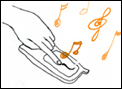 |
Ring uses gestures to produce real-time sound that can contain both information and expression, making the ring a unique, non-verbal communication piece. As in the knocking SOMO project by IDEO, the interesting aspect of Ring is in the potential for the development of personal languages’ of ringing. |
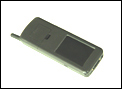 |
In the initial Ring prototypes, ringing gestures are made with the fingers using a touch-pad surface on the exterior of the phone device. Touching the pad at different locations produces different sounds. The pad space is mapped to a sound ‘palette’. |
• S h a k e •
(with Mathias Dahlstrom )
- How can portable music-sharing be an activity performed between people, not between devices?
Shake is an audio-tactile system for sharing music between people in the same space.
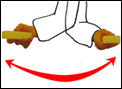 |
Shake uses gestures to perform the social interchanges involved in sharing music with others. The sharing functions were mapped into a gesture vocabulary performed with the music device. The gestures involve arm motions such as shaking and sweeping. Performing the gestures creates real-time modifications of the music in synchrony with the gesture - exploring the natural connection between music and body movement. |
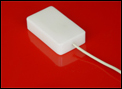 |
Music modifications are achieved by applying filters and effects over the music, in ways that both provide feedback for the gestures and enhance the expressive experience of performing them. In the Shake prototype, an abstrated "player" with an accelerometer passes gesture data to a computer. Real-time sound modifications are generated using MAX software. |
Next > Conclusions
 |
|
Audio-Tactile • Michal Rinott • Thesis Project • Interaction-Ivrea 2004 |
|